

RESILIENCE UNDER PRESSURE
Q3 REVIEW
- Equity market returns were broadly flat over the quarter, masking considerable volatility beneath the surface. In the face of rising bond yields, higher oil prices, renewed geopolitical tensions and ongoing concerns around AI investment, markets proved remarkably resilient.
- The quarter began with a sharp reversal in parts of the semiconductor sector that had dominated market returns for much of the year. These falls precipitated the unwinding of significantly over-leveraged positions, claiming a notable victim in the ironically named hedge fund “Situational Awareness”. Notwithstanding share price moves, earnings results have generally remained supportive.
- Renewed hostilities in the Middle East drove a 40% increase in oil prices, pushing gasoline and diesel prices to highs and consumer confidence indicators back towards lows. As tariffs returned to the agenda, inflationary fears resurfaced, with Europe proving particularly sensitive.
- With pricing pressures in mind G7 central banks have reversed course and begun hiking interest rates. The UK has proven the outlier, standing pat, but Governor Andrew Bailey has intimated it is a question of when rather than if UK rates rise, with four increases currently forecast over the next year.
- With budget deficits elevated and governments showing little appetite to tackle high debt levels, pressures from interest rates, oil and inflation were reflected in sovereign bond markets. Prices fell as yields rose to multi-decade highs. 10-year UK Gilts and US Treasuries ended September firmly above 5%. This further undermined the haven credentials of longer-dated government bonds.
- Artificial Intelligence (AI) remains the dominant market theme. Capital investment across data centres, semiconductors and power infrastructure continues to surge, with the leading tech businesses committing to trillions of dollars of spending. However, the scale of this investment has raised concerns that spending may be excessive and that greater reliance on debt financing could heighten the risks.
- Those additional risks might prove existential to humanity given statements on AI’s progress by its leading figures such as Anthropic’s Dario Amodei and OpenAI’s Sam Altman. For now, the bigger challenge appears political. The impact of data centres on local communities has made them a key issue of the upcoming US midterm elections with a potential Democratic clean sweep likely to bring greater scrutiny.
- Economic activity remained resilient despite these headwinds. Inflation proved
more contained than many feared, labour markets remained broadly healthy and manufacturing activity continued to improve after an extended period of weakness. US Q2 GDP has recently been revised upwards to an above-trend 2.2% from 1.5%. - As explained in our quarterly comment, corporate earnings growth has remained the most important support for equity markets. The rate of growth has only been surpassed on two occasions this century, the recession recoveries of 2010 and 2021.
- The combination of economic resilience and corporate profitability has allowed equity markets to absorb the litany of shocks alongside rising bond yields and borrowing costs. Indeed, the strength of earnings alongside sideways trending markets has meant that equities have become cheaper through the quarter and now look more reasonable against long-term averages.
- We remain constructive on equities, although increasingly selective given building pressures and changing vulnerabilities. Higher rates, energy prices and yields are likely to slow activity at least temporarily.
- AI remains a key factor in markets both given its dominance as a driver of the investment cycle and in its capacity to disrupt established industries and corporate incumbents.
- Higher bond yields have increased the attractions of shorter-dated issues even as government bond markets have once again shown that they remain subject to complex risks. This supports our view that other assets such as gold and hedge funds offer attractive balance to portfolios.
- Although political noise will continue to buffet markets from week to week, corporate earnings have been a more reliable driver of returns and have underpinned this year’s strong growth. Earnings remain our primary focus in the coming weeks, while we stay alert to the risks posed by an increasingly fragile and fragmented global backdrop.
At the start of the year, the foundations for financial markets appeared supportive.
Interest rates were falling, fiscal policy was stimulating economic activity, investment in Artificial Intelligence (AI) continued to accelerate and, after nearly three years of recession-like conditions, manufacturing and industrial activity finally showed signs of recovery. The prospect of US midterm elections later in the year offered a further incentive for the Trump administration to sustain economic momentum.
Much has since gone wrong.
Renewed conflict in the Middle East pushed oil prices sharply higher. Tariffs continued to distort global trade and inflation. Government bond yields rose, with the US ten-year Treasury yield breaching 5% and dragging mortgage rates higher with it. Investors became increasingly concerned that the scale of spending on AI infrastructure would prove excessive, while the capabilities of new AI models raised uncomfortable questions for many previously dominant technology companies.
Yet once again, the global economy has proven more resilient than many expected, with most major equity markets close to record highs.
This is not because investors have ignored the risks. Share prices have moved sharply beneath the surface, valuations have declined in several highly rated parts of the market and leadership has shifted repeatedly, particularly over the past three months. Instead, the positive forces supporting corporate earnings have so far proven stronger than the succession of political and economic shocks thrown at them.
The central question for investors is whether this resilience reflects durable economic strength or a growing complacency.
EARNINGS HAVE DONE THE HEAVY LIFTING
Equity markets have remained resilient because corporate profits have continued to confound expectations. Profit margins remain healthy, balance sheets are generally sound and earnings growth has broadened to a wider range of industries. Following a robust Q2 earnings season, US company profits are now expected to grow by over 30% in 2026, one of the strongest periods of earnings growth outside post-recession recoveries (Fig. 1).
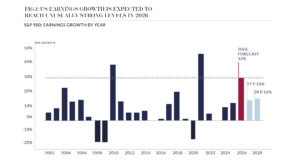
SOURCE: JH&P, JPM ASSET MANAGEMENT, S&P. FORECASTS FOR 2026, 2027 AND 2028 REFLECT CONSENSUS ANALYST EXPECTATIONS, PROVIDED BY FACTSET.
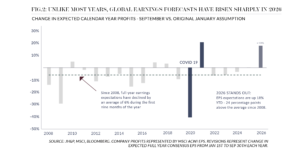
The scale of the growth is striking, but the way it has developed through the year has mattered even more. Analysts’ annual forecasts for companies’ earnings usually start too high and are revised down as the year progresses, falling by around 6% on average by the start of the fourth quarter. This year has been very different. Analysts have raised their profit forecasts for companies around the world by 18% since the start of 2026, the largest upgrade in the last 20 years, outside of the post-Covid rebound of 2021 (Fig. 2).
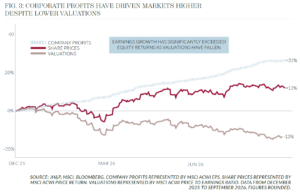
In short, strong earnings growth has allowed global equity markets to withstand considerable disruption. Rising profits have more than offset the effect of lower valuations brought about by higher bond yields and economic uncertainty (Fig. 3).
This earnings growth has several drivers. Fiscal policy remains supportive, consumers have continued to spend and AI investment is reaching an increasingly broad range of industries. What began as a cycle concentrated in software and semiconductors is now reaching further into power generation, electrical equipment, infrastructure, automation and supply chains. None of these supports is immune to a slowdown, but together they have provided a powerful offset to tariffs, higher oil prices and elevated interest rates.
A CAPITAL INVESTMENT BOOM SPREADS THROUGH THE ECONOMY
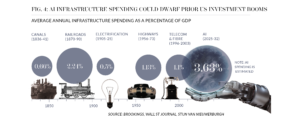
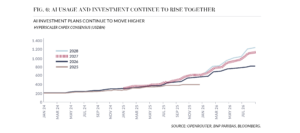
The scale of AI infrastructure spending has become an economic force in its own right. New estimates from Brookings, a prominent US policy think-tank, now forecast that US AI infrastructure spending will total more than $10 trillion between 2025 and 2032, representing roughly 3.6% of US GDP each year. On an average-annual basis, that would exceed any prior technology rollout in American history, surpassing the railroads, the interstate highway system and the internet (Fig. 4).
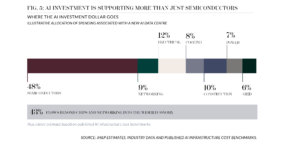
Much of the recent discussion around AI infrastructure has focused on whether individual technology companies will earn adequate returns on this investment. That matters for shareholders but misses the more immediate economic effect. Every dollar invested in a new data centre becomes revenue for somebody else. Semiconductor manufacturers supply the chips. Electrical equipment companies provide switchgear and power distribution systems. Utilities build generation capacity. Construction firms, engineers and specialist contractors design and deliver the facilities. What begins as technology spending quickly ripples through the wider economy (Fig. 5).
The resilience of the mighty US consumer has provided another important support for markets. Higher living costs and elevated borrowing rates might ordinarily have produced a sharper retrenchment in spending. Instead, stable employment, continued fiscal support alongside tax cuts and rebates and rising asset prices have helped many households absorb the strain.
There is an important feedback loop at work. Strong financial markets increase household wealth and confidence, supporting consumption. That spending supports corporate revenues and profits, which in turn reinforces markets. While this dynamic primarily benefits wealthier households and should not be mistaken for broad prosperity, it has nevertheless provided a meaningful cushion for economic activity.
Together, rising investment and continued consumer spending have given the economy more momentum than many expected, helping corporate earnings withstand higher interest rates, tariffs and rising energy costs.
BUILD-OUT OR OVERBUILD?
History suggests that large corporate investment cycles often end in overcapacity and disappointing returns with the shadows of the railroads and internet looming large. So far, however, there are few signs that we have reached that point. AI usage continues to rise rapidly, investment plans are still being revised upwards and key parts of the supply chain remain constrained.
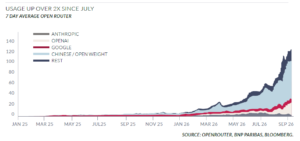
Use of AI services has more than doubled over the past few months as models become more capable, new applications emerge and AI systems take on more tasks for users (Fig. 6). Businesses are using AI not simply to search for information, but to write software, analyse data, interact with customers and increasingly perform tasks autonomously. Industry estimates suggest that revenues generated by Anthropic and OpenAI have risen sharply during 2026. At current levels of demand, the two leading AI labs are thought to be generating combined revenues equivalent to over $130 billion a year, a more than four-fold increase from $30 billion at the start of 2026. For context, only three FTSE 100 companies generate more revenue, while HSBC, the next largest, generates little more than half as much. Within about five years of commercialisation, both businesses are on pace to become amongst the largest software and internet businesses ever created. Anthropic could be valued at more than $2 trillion when it lists on the US market, potentially before the end of the year.
The economics of the underlying infrastructure also remain unusually strong. Despite a wave of new investment, computing capacity remains scarce and rental prices for AI computing power continue to rise. This has helped large cloud providers such as Alphabet and Microsoft deliver rapid growth and strong returns on investments made in recent years.
Future spending commitments and the widening gap between reported earnings and free cash flow still deserve scrutiny. The returns on today’s investment remain uncertain. However, as earlier data centre investment begins to generate revenue and existing contracts are repriced to reflect stronger demand, the largest technology companies should be able to fund more of the next phase of investment from their own cash flows rather than having to return to debt markets.
None of this guarantees that the AI investment cycle will ultimately prove rational. Some projects will disappoint and some spending may prove to have been excessive. But periods of heavy capital spending often support economic activity and corporate earnings for far longer than expected. For now, the evidence suggests that adoption is still accelerating rather than slowing.
THE ECONOMICS OF FRICTION
Continued AI progress creates an important tension for investors. The investment supporting growth today may prove much more disruptive over time. As AI tools become more capable, they will increasingly be able not just to provide information, but to make decisions and carry out tasks. These ‘AI agents’ could change the way consumers behave and weaken business models that partly benefit from consumer inertia, complexity and weak competition.
For most of history, businesses have competed for the attention of human beings. They have advertised to us, negotiated with us, frustrated us and occasionally exploited our laziness. We forget to redeem loyalty points, remain on uncompetitive phone and utility tariffs and rarely have time to search for every available alternative. AI agents would not share these weaknesses. They could compare prices, switch providers and manage recurring financial decisions continuously on our behalf.
The implications extend well beyond retail. Banks may find it harder to retain deposits in low-yielding accounts if agents continually search for better rates. Insurers could face higher claims as agents navigate forms, exclusions and appeals on behalf of customers. Travel platforms and comparison sites may also be challenged if agents can search, compare and book directly.
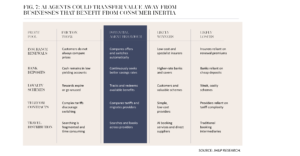
Not every established business will lose. Those that reduce customer friction could see demand expand. Companies that become trusted infrastructure for agents may gain new distribution advantages. Payment networks, identity verification providers and software platforms that enable secure agent-to-agent transactions may become increasingly important.
The largest opportunity may belong to firms that control the relationship between the consumer and their digital agent. Historically, companies competed for clicks. In the future, they may compete for recommendations generated by software agents acting on our behalf. The battle could shift from grabbing human attention to earning the trust of machines.
WHAT WOULD DISRUPT THE PICTURE?
There are many risks facing markets today, but three stand out.
1. AI SPENDING SLOWS MORE SHARPLY THAN EXPECTED
The current cycle is underpinned by an extraordinary level of capital spending, particularly on AI infrastructure. Unlike the late 1990s internet bubble, today’s investment is being led by highly profitable companies with substantial cash flows. Even so, funding requirements continue to rise. For now, usage, revenues and earnings remain supportive. However, if demand for AI services disappoints, returns on investment prove lower than expected or capital discipline weakens, spending could slow more abruptly than markets currently anticipate. Given how many industries now benefit from this investment cycle, the consequences would extend well beyond the technology sector.
2. THE CONSUMER HAS LESS ROOM FOR ERROR
The post-pandemic savings buffer has largely disappeared, borrowing costs remain high and the benefits of rising markets accrue disproportionately to wealthier households. Most consumers have coped with these pressures individually, but the combination of higher oil prices, weaker employment, renewed rate pressure and falling asset prices would be much harder to absorb.
The consumers have proven redoubtable but are not impervious. If pressures continue to increase they could reach a tipping point where spending contracts.
3. POLITICS AND INTEREST RATES BECOME A LARGER HEADWIND
Markets have largely looked through tariffs, fiscal deficits and renewed geopolitical tensions on the assumption that the economic impact will remain temporary and manageable. So far that has proven correct.
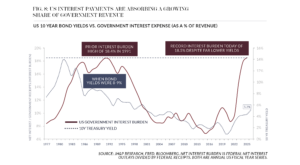
However, high levels of government debt have made the global economy increasingly sensitive to borrowing costs that would once have seemed relatively ordinary. US federal interest payments now consume almost 20% of government revenue, slightly above the previous peak in 1991, despite long-term interest rates still being far lower than they were then (Fig. 8). An imminent fiscal crisis is unlikely. The more immediate problem is that higher interest costs leave governments with less room to respond and support the economy when growth slows.
The risk is that these pressures begin to interact. If higher oil prices, tariffs or bond yields keep monetary policy restrictive as growth slows, markets would have less room for error. Investors can live with higher discount rates when earnings are rising, balance sheets are healthy and inflation is moderating. However, they are less forgiving when those higher rates coincide with weakening profits.
RESILIENT, BUT NOT INVULNERABLE
We continue to see reasons for optimism. Company earnings are growing strongly, AI investment is generating tangible demand across a widening range of industries and the long-awaited recovery in manufacturing and industrial activity appears to be broadening. Corporate balance sheets are generally stronger than in previous periods of heavy capital spending, while several areas beyond the largest technology companies offer improving growth at less demanding valuations.
However, the foundations are uneven. Consumer savings have been materially depleted, higher oil prices threaten both inflation and growth, government borrowing is placing pressure on long-term interest rates and the AI investment cycle remains vulnerable to eventual overcapacity. Markets have absorbed these risks remarkably well, but they have not disappeared.
This backdrop places a greater premium on understanding where earnings growth is coming from and how durable it may prove. Some businesses are benefiting directly from the current capital investment boom. Others may enjoy only a temporary lift from spending that eventually creates excess capacity.
A third group faces a more fundamental threat as AI makes it easier for consumers and companies to compare, switch and transact. AI may also bring new opportunities and enable new businesses that are not yet visible.
Exposure to a powerful investment cycle is not, by itself, evidence of a durable competitive advantage. Amphenol, for example, is benefiting from the data centre build-out, but its investment appeal extends beyond it. Its engineering expertise, customer relationships and exposure to aerospace, defence, automotive and industrial markets provide several potential sources of long-term growth should AI investment stumble. Visa could benefit in a different way. As AI changes the way customers compare and transact, trusted networks capable of authorising payments securely and at scale could become more valuable.
Equally, we are scrutinising businesses whose economics depend on inertia, opaque pricing or barriers that technology may remove. The consequences will depend less on the sector label than on the competitive strengths and adaptability of the individual business.
For equity selection, this means combining beneficiaries of today’s capital spending with companies capable of adapting to tomorrow’s disruption, supported by strong balance sheets and valuations that leave room for disappointment. Across portfolios more broadly, today’s economic and political environment continues to support greater exposure to diversifying assets that can respond differently to inflation, weaker growth or renewed volatility, particularly when the defensive qualities of traditional government bonds appear less dependable than in the past.
Markets have survived a remarkable succession of shocks this year. Whether that resilience endures will depend largely on whether earnings continue to justify investors’ confidence.
For now, the forces supporting the economy remain substantial, but resilience at the market level increasingly conceals a widening divide between the companies benefiting from change and those at risk of being disrupted by it.
Article written by Dan Zegleman, Portfolio Manager.
This document is a Financial Promotion for UK regulatory purposes and is directed only at investors resident in the United Kingdom.
This document does not constitute investment advice or a recommendation.
Past performance is not a reliable indicator of future performance. The value of investments, and the income from them, may go down as well as up, so you could get back less than you invested.
This material has been issued and approved in the UK by James Hambro & Partners LLP, which is authorised and regulated by the Financial Conduct Authority and is a registered investment adviser of the Securities and Exchange Commission. It is listed in the Financial Services Register with reference number 513246. James Hambro & Partners LLP is a limited liability partnership registered in England & Wales with number OC350134 and registered office at 45 Pall Mall, London SW1Y 5JG. A list of members is available on request. The registered mark James Hambro® is the property of Mr J D Hambro and is used under licence.