

STILL A CASE OF CHIPS WITH EVERYTHING?
In a quarter that saw equity markets recover all of the losses of March and more, it was not a putative agreement between the US and Iran to cease hostilities that catapulted the US and a range of global indices to new highs but a blockbuster earnings season built on an ever-rising commitments to spending on Artificial Intelligence (AI).
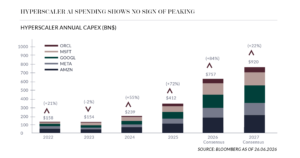
With the economic fallout of the Gulf conflict seemingly manageable, investors were sufficiently emboldened to zero in on increasing capital investment commitments from the world’s biggest companies. That number looks to be nearly $800 billion this year. Nearly twice the spending in 2025 and more than the cost of Franklin D Roosevelt’s New Deal in today’s money. The leading recipient of this wave of capital has been the semiconductor or “chips” sector which sits at the bottleneck of core computing power and memory essential to support demand for AI.
The sector bellwether Philadelphia Stock Exchange Semiconductor Index rose by nearly 70% over the quarter, dominating returns as a series of leading companies, such as the US’ Micron, reported jaw dropping increases in profits and margins. For much of the quarter it appeared the only game in town for equity investors, and justifiably so given short term momentum. However, the semiconductors industry is notoriously cyclical and so the longer-term health of this trend will be dependent on how sustainable this capital cycle is.
That remains a key question for the coming months as do questions about the broader health of the US and global economies, the trajectory of interest rates and whether the reverberations of war in the Middle East will continue to exert upward pressure on inflation. AI is not the only economic force in the world and remains a technology whose financial benefits and returns remain largely unproven. As any nutritionist will tell you, a healthy market cannot survive on a diet entirely made up of chips.
VIEW IN SHORT
- Equity markets recovered strongly after the March sell-off, with the rebound driven less by the easing of Gulf-related fears and more by an exceptional earnings season linked to AI and data-centre investment.
- The AI capital-spending cycle remains the dominant market theme. Spending commitments by the five hyperscalers of Microsoft, Oracle, Amazon, Alphabet and Meta have risen sharply, with 2026 spending approaching $800 billion and forecast to continue growing over 2027 and 2028.
- Semiconductor and memory chip manufacturers have been the clearest beneficiaries, reflecting their position as the key bottleneck in AI compute; profits, margins and share prices have surged, particularly in the US, Korea and Taiwan.
- The strength of the chip cycle is founded on strong earnings momentum, but the industry is historically Markets now need evidence that today’s demand can translate into sustainable returns rather than future overcapacity. Expectations have been set high for the upcoming reporting season.
- The hyperscalers, who are funding the boom, face a more mixed Demand for their cloud services remains strong but their prodigious cashflow is increasingly being redirected from buybacks to AI infrastructure spending, raising questions about returns on invested capital. They will need to demonstrate a return to justify future spending which will have ramifications for the entire technology sector.
- Markets have been swift and uncompromising in categorising AI winners and losers. Chips have justifiably led, while software and data-services companies have been heavily The next phase is likely to require a more nuanced assessment of where AI profits ultimately accrue both at the infrastructure level and increasingly to the adopters and applications that sit above large language models.
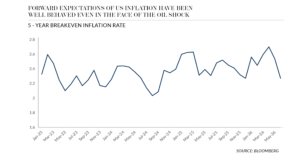
- Beyond technology, the global economy has remained robust: the oil shock has so far been contained, inflation expectations have remained anchored, and the structural themes of infrastructure, electrification and energy-security continue to broaden the opportunity set beyond AI.
- These structural trends support our more balanced portfolio positioning. We retain judicious exposure to the beneficiaries of the rapid adoption and build out of AI but avoid Given a wider range of investment themes, we remain committed to using diversification across sectors, geographies and styles as a means to build resilience without diluting returns.
- The geopolitical regime remains characterised by fragility, with deglobalisation, supply shocks and higher structural inflation reinforcing the need for protection. However, given the shifting global regime it is vital to constantly reassess sources of reliable Previously dependable sources of protection such as bonds have been found wanting, prompting us to seek alternative ways to balance portfolios.
- The AI boom is powerful and well supported, but expectations are high, leaving markets vulnerable to disappointment; a healthy portfolio cannot thrive for long on a diet entirely based on chips.
LOOSENING THE STRAIT JACKET
Markets began the quarter optimistically given the ceasefire in the Gulf announced at the end of March and barely looked back, even though the supposed four-week conflict continues to be beset by skirmishes more than four months on. That optimism was founded on a belief that the pause in hostilities reflected the political and economic realities for most parties; effectively meaning it was a question of when, not if, the Strait of Hormuz would re-open.
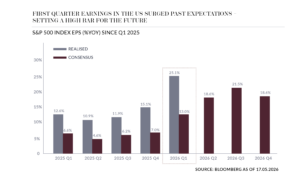
That improving sentiment was supercharged by an extraordinary corporate earnings season. Realised earnings growth in the S&P 500 surpassed 25%, blasting past market forecasts for 13% growth. Expectations for the ensuing quarters and full year were materially upgraded. This was driven by strength not just from the technology sector, but a breadth of companies exposed to the surge in capital spending associated with the artificial intelligence (AI) and data centre (DC) mega-trend. This scale of profit growth has rarely been seen outside of recoveries from economic slumps – with the escape velocity from COVID the last time we saw growth at this rate.
The so-called hyperscalers of Microsoft, Google, Amazon, Meta and Oracle continued to spend like sailors on shore leave. Increasing their 2026 spending commitments to $757 billion (equivalent to 2.5% of US GDP), an upgrade of over $85 billion in only three months, as confidence in future returns built and future profit expectations were raised. The US market was again at the front of the recovery given its technology-based leadership and its greater energy resilience, but the improving sentiment supported a broader bounce across equity markets.
However, with the Strait of Hormuz remaining closed and a US blockade in place, concerns over the future economic impacts, not least on inflation, lingered. This kept bond markets subdued and spot oil prices elevated through the end of April and saw those regions and sectors most vulnerable to disruptions in energy supplies and prices lag the recovery.
WHEN THE CHIPS ARE UP…
With initial optimism over the Gulf quickly fading as the US failed to make negotiating progress, markets responded in much the same way that they did 12 months earlier during the uncertain period that followed the shock of the Liberation Day tariff announcement. Focus intensified on those trends and themes that looked iron clad irrespective of the trajectory of geopolitical disruption. In this instance investors zeroed in on the recipients of the huge spending emanating from Microsoft et al; those sitting at the key supply bottlenecks of memory chips and semiconductors. The essential resources to underpin the scaling of AI compute and facilitate the next stage in the evolution of large language models, agentic AI and inference.
For context, the semiconductor industry has historically been highly cyclical, subject to large swings in profitability with any surge in customer demand ultimately met with investment in new supply leading to overcapacity (at least in the short term). The AI revolution has super-sized that demand cycle, fueled by deep-pocketed companies willing to spend whatever it takes to make sure they do not find themselves left behind. Annual spending is forecast to exceed $1 trillion by 2030, with many chip companies confident in the visibility of order backlogs stretching into years rather than quarters. The parallels with the resource super-cycle earlier this millennium as China embarked on an infrastructure boom are worth considering, not least when some analysts and CEOs are tempted to conclude that it’s different this time and these companies are no longer cyclical.
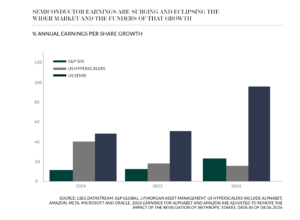
Whether cyclical or not, the size of the spend has driven a remarkable surge in profits. Having seen earnings rise 50% in 2025, semiconductor earnings are forecast to at least double in 2026 as the largest technology companies have continued to double down on spending commitments.
Nowhere is this more evident than in South Korea where the local Kospi Index rose 68% over the quarter driven by the returns from Samsung and SK Hynix; dominant forces in a memory chip oligopoly and now accounting for 50% of the local index. Samsung’s most recent results showed a 19-fold annual increase in quarterly profits. Chip sales are driving South Korean export growth to record levels and historically where Korean exports have led, US earnings have followed.
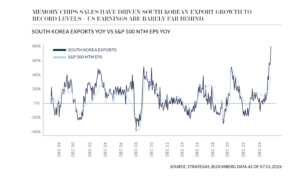
The story is the same in Taiwan where TSMC (Taiwan Semiconductor Manufacturing Co) is a full 40% of the local stock market. The insatiable demand screams from the data; the 70% surge in Korean exports over the last twelve months owes everything to semiconductors.
Whilst there are signs of exuberance and we would expect a period of consolidation in share prices, the fundamental underpinning looks solid at this time. All three stocks have been important constituents of our Asian fund investments, so much so that the underlying exposures rank these stocks in the top 40 holdings in portfolios and amongst the leading drivers of returns since 1st April. We are monitoring that exposure.
THE RISING TIDE OF SPENDING IS LIFTING PLENTY OF BOATS
The flow of money can be seen beyond Asia and throughout the wider semiconductor industry. Texas Instruments in the US, Infineon in Germany and even perpetual laggard Intel have benefited from a demand surge for all things AI and DC related so powerful that considerations of quality have been cast aside. Friends in the White House have not harmed Intel’s prospects either!
Alongside the capitalist zeal the demand cycle has received additional impetus from one of the structural trends that we have consistently highlighted in recent years, the drive by national governments to ensure the security and resilience of supply of key resources. Semiconductors are in that category with national governments increasingly forming strategic partnerships or taking stakes in national champions, whether through the CHIPS Act in the US or the imaginatively named EU Chips Act which is supporting construction of facilities from Dresden to Zaragoza.
The spending boom is trickling down through the various layers of the AI and data centre infrastructure. It was announced on the 29th of June that SK Hynix and Samsung would be building two new semiconductor plants as part of a more than $500 billion commitment by South Korea to further build out its AI infrastructure.
These spending commitments will cascade down and support demand throughout the semiconductor supply chain, driving the earnings and profit growth that have underpinned the recent move in markets. As more foundries are built so more equipment will be needed to fill them and infrastructure to power them, including the advanced lithography and etching equipment made by the Dutch company ASML which holds a near monopoly in the space or the grid infrastructure and power systems produced by Siemens Energy described last quarter.
At the World Economic forum Davos in January, Jenson Huang, CEO of Nvidia, described AI as a five-layer cake made up of energy, chips, cloud infrastructure, models and applications. At this point in time the returns are flowing most tangibly to the layers at the bottom of the cake where profits are accruing to the builders of the infrastructure. However, if the returns are to be sustainable then we will need to start seeing evidence of and confidence in the returns coming from those layers closer to the icing at the top; the models and applications.
THE WHEELS CAN KEEP SPINNING AS LONG AS THE CASH KEEPS FLOWING
Like any cyclical industry, the going will remain good for the chips and semi-conductor manufacturers as long as the demand and the cash keeps coming. This is why there will be so much focus on the capital commitments of their biggest customers.
Here the mood music has remained positive, with evidence that companies are willing to keep spending and that investors are willing to finance it. In recent months we have seen Anthropic raise $64 billion from private investors, valuing the five-year-old company at nearly $1 trillion. Google parent Alphabet announced an $80 billion equity issue in June adding to the $85 billion it raised in debt in 2025, whilst SK Hynix has sought to take advantage of US investors love of chips (silicon rather than potato) by announcing an intention to raise nearly $30 billion through an equity sale on the American market. And then, of course there was SpaceX!
As a show of confidence and commitment management teams are betraying few signs of easing off their investment, justifying recent investor enthusiasm which has followed the surge in earnings rather than anticipated it. Where there is optimism is in expectations for the duration of this cycle which has set the bar high both for earnings and future returns.
The upcoming results season will require careful watching. Market sentiment and positioning exhibit a level of confidence in the trajectory of this theme that leaves little margin for error. It is for this reason that we have looked to retain balance in portfolios, retaining exposure to beneficiaries of the spending without being all in. The semiconductor cycle has been THE market story and has been built on strong fundamentals. However, in recent years markets have consistently reminded us that facts and fashions can change in a flash. Just ask yesterday’s heroes, the Magnificent 7.
THE NOT QUITE AS MAGNIFICENT 7
If the recipients of the AI capital spending are basking in surging share prices supported by surging profits, then what of those doing the spending?
Here the picture is less clear. As they have dedicated more and more of their free cashflow to capital investment in AI infrastructure, so the share prices of the biggest tech companies have lagged the wider market. As a group their shares have returned 2% this year as against a return of 10% for world equities.
We can understand why more recent returns might have trended to the pedestrian. Whilst their earnings have continued to grow and to do so at a decent clip, other areas of the market are now growing more quickly and do not face questions as to whether the colossal investment that Alphabet, Microsoft, Amazon, Oracle and Meta are undertaking will actually generate a return. In addition, one of the great supports for the group has been their prodigious cash generation stretching into the hundreds of billions of dollars. This huge capital generation had allowed them to not only invest to strengthen their businesses but also to return billions to shareholders through buybacks supporting prices. Alphabet alone bought back $249 billion of its own shares in the five years to 2024.
That cashflow has now been diverted to an ever-rising investment in AI; the returns on which remain to be proven. With investors focussing on what they consider to be the “sure things” whilst the hyperscalers are increasingly taking on debt to fund investment the equation has changed and markets have become increasingly reluctant to give them the benefit of the doubt, even if their debt levels remain low.
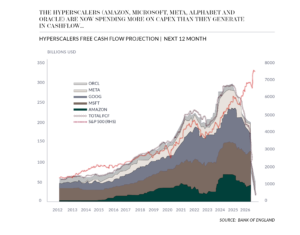
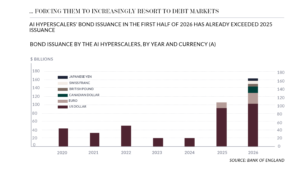
Whilst often referred to as a collective, in reality these seven major companies are very different with a breadth of drivers, business models and end markets. They are united by their size and success but have also delivered very different investment returns for long periods. We have always felt it important to judge the investment attractions of Google, Microsoft, Apple, Tesla et al on their own merits. Avoiding investment in Meta, Tesla and Apple so far this year has been nearly as consequential for returns as owning the chip stocks.
At various points over the last twelve months both Alphabet and Microsoft have been deemed AI losers and been left behind by the markets. Alphabet cast off that moniker to be seen as the AI winner of the Mag 7, returning over 100% since. It is Microsoft that is currently cast as the laggard, without a leading model or its own chip architecture and lumped in with the rest of the software sector that has been deemed fundamentally challenged by the prospect of being replaced by agents and LLMs.
With the ultimate impact of AI unproven we accept that this could prove the case, but the evidence so far is patchy at best. It is equally credible that some of the most successful and dynamic companies of the last quarter of a century prove adept at turning their substantial investment into returns. In the first quarter Alphabet reported annual revenue growth of c.20% and operating income up 30%. For Microsoft those metrics were 15% and 20%. In isolation these are strong results and it would be tempting to see them as having earned the benefit of the doubt. After all, the most recent results illuminated the fact that they are investing to meet the soaring cloud computing demands of their customers (including the leading AI models). If excess demand is driving profits for the chip companies will the same not be true for the cloud compute divisions of Google, Amazon and Microsoft?
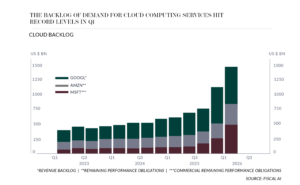
With the demand backlog for the cloud services of Amazon, Microsoft and Alphabet having hit record levels in April, the hyperscalers offer an interesting opportunity. If they continue to deliver expected levels of growth and begin to demonstrate a return on AI investment, then investors will be forced to reassess and revisit them. If the returns on investment prove insufficient then they will pull back on spending and instead revert to sending excess cash back to shareholders. In either event they could perform better in the months ahead and once again lead the broader index.
THE JURY IS STILL OUT ON AI WINNERS AND LOSERS – EVEN THOUGH THE MARKET REMAINS KEEN TO DELIVER A VERDICT!
AI continues to cast its shadow over markets. Touching all sectors and industries it is likely to be the chief arbiter of market direction in the coming quarters. It continues to exert powerful influence on sentiment with market participants quick to rule on winners and losers.
Chips have been the clear winners, whilst loser status has been writ large across the software and business data services sectors of the market. They remain in the dock, guilty until proven innocent at a time when it is too early to tell with any certainty whether or not their business models will be superseded by models and vibe coding. In some cases, this looks to have gone too far but the likes of Adobe, Accenture and Intuit have remained victims of negative sentiment despite cheaper valuations and stable earnings; they fell between 15% and 40% in the quarter despite having fallen by 30% or more in the previous 12 months. It has not been an environment to bet against the trend.
We think that markets will move beyond such a binary approach in the coming quarters. Adopting an increasingly nuanced assessment of the implications of AI, with the burden of proof potentially shifting to the proponents of AI rather than the purported victims.
The biggest question remains what the returns on all that AI investment will be and to whom the profits will accrue? Will it be the hyperscalers, the model providers, the application builders or those businesses that are integrating AI into their existing enterprises? For AI’s potential to be realised and the capital spending to continue it is likely to be some combination of all of the above. In the opinion of the new US Federal Reserve chair Kevin Warsh, it will be existing businesses that will prove the real beneficiaries of a productivity enhancing technology. Ultimately driving a disinflationary boom that will allow him to keep rates low and the President becalmed.
Our view is that the next year is likely to see much more focus both by investors but also by Chief Executives, Chief Financial Officers and Chief Technical Officers of companies on seeing a return on their current spending. As BCA Research put it AI will need to move “from turning silicon into compute to turning compute into dollars”. Will the flush of enthusiasm be sustained and will the costs of AI withstand contact with the return targets of management teams?
For the frontier model developers there are positive signs of revenue growth is coming through. Anthropic is reportedly seeing monthly revenue growth consistent with achieving $60 billion of annual revenues and moving into profit this year, barely five years since it was founded. To justify its $1 trillion valuation it needs to see that rate of growth continue and to do that it will need companies to continue to pay for Claude, Fable, Mythos and Opus. A building concern here is the growth in Chinese AI models. Fuelled by cheap and plentiful energy they could flood the market and undercut the pricing of the frontier providers in the US. That is, if western governments allow it.
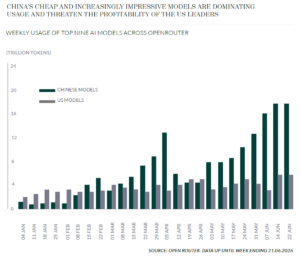
Government interference is a building risk to sentiment. We have already seen the US government raise AI as a matter of national security, the Pentagon get into a fight with Anthropic and the President limit the export of new frontier models. Government interference could blunt the cadence of innovation.
With sentiment and expectations high any impediment to hitting growth targets would disappoint markets.
THERE IS STILL MORE TO THE WORLD THAN TECHNOLOGY
We have talked a lot about AI because it has been the driver of markets and is likely to be the key determinant of sentiment and market direction in the coming quarters.
However, the global economy remains more than technology and AI. There are a wealth of sectors that provide opportunities for growth and, importantly for us, avenues to diversify the risks in client portfolios.
Having been overlooked for much of the quarter given the latent threats to economic activity and inflation emanating from the Middle East there are large sectors of the market that continue to be attractive and are supported by both structural trends and an economic cycle that has repeatedly surprised in its ability to withstand a litany of exogenous shocks.
The economic impacts of the surge in oil prices and restrictions on supply look to have been contained so far. Despite the fact that an actual agreement remains outstanding and that shipping through the Strait of Hormuz continues to be hazardous, oil prices have fallen back. Fears of the stagflationary shock that roiled markets have receded and, whilst near term inflation is running hotter, longer term measures of inflation show no signs of concern.
The US economy has remained the leading light through the disruption but even the UK and Europe, despite growth being downgraded, look set to grow, albeit modestly. The fiscal stimulators of Trump’s signature One Big Beautiful Bill Act have helped cushion the US economy through this period with tax rebates ensuring that consumer retail spending has barely skipped a beat, whilst generous capital allowances and de-regulation have continued to embolden corporates to invest.
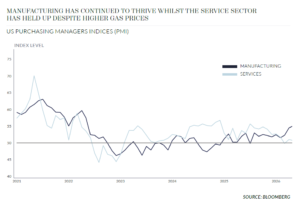
The strength in manufacturing has not been confined to the US. As we wrote last quarter the opportunity set continues to broaden beyond bits to atoms, to steel over software and megawatts alongside megabytes. The structural drivers and imperatives have only been strengthened by events in the Middle East. Events continue to underscore the imperative for companies and nations to prioritise security and resilience over efficiency and reliance on the generosity of others. They are starting to respond.
Reshoring, infrastructure renewal, electrification and energy security provide huge opportunities for growth for companies providing the resources and engineering expertise to support these multi-year opportunities. The demand for capital spending is growing and is not purely reliant on the single drivers of AI and data centres. This has increased our ability to diversify portfolios by sector, by geography and by investment style without feeling we are compromising on the potential for growth.
To the list of companies mentioned last quarter, including Emerson in automation and process controls, Siemens Energy in power demand and electricity grid renewal and CRH, one of the largest construction materials and infrastructure solutions providers in the US and Europe, we added Eaton. Eaton provides mission-critical hardware to manage and control the safe distribution of electricity in utility grids, industrial facilities, commercial buildings and of course data centres.
Industrials now represent one of the largest exposures in equity portfolios and the most significant overweight relative to the market. We are comfortable in that position given our research over the last few years alongside data that point to the long anticipated industrial manufacturing recovery and broadening at last being here.
THINKING ABOUT ARKS WHILE THE WEATHER’S DRY
We are excited and optimistic about the range of opportunities today, especially with oil prices below $100, growth resilient and policy supportive. However, we recognise that deglobalisation and the post COVID environment of higher inflation, higher rates and flaying international co-operation have rendered the world more fragile and more volatile. Supply shocks have become a more regular event this decade, both man made and at the hands of mother nature. Projections for this year’s El Nino point to material risks to southern hemisphere harvests and more extreme weather events across the world, not least the continental US.
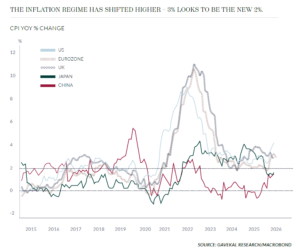
This leaves markets and economies vulnerable to being rapidly blown off course by external events. Worse still these external events have tended to come with an inflationary hue meaning old modes of protection have proven less effective. Longer-dated bonds have repeatedly failed to offset equity risks whilst central banks have found themselves backed into a corner where they are unable to cut rates in the face of a crisis, in fact quite the opposite.
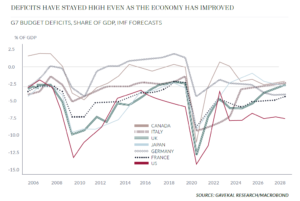
Budget deficits have grown despite recent economic resilience, potentially limiting the flexibility of governments to respond to crises by turning on the fiscal taps. Bond market vigilantes may challenge the fiscal credentials of future leaders as they famously did Liz Truss.
This is why we continue to seek both balance and resilience in portfolios. Part of that resilience comes from a preference for companies whose financial structure and balance sheet allows them to withstand shocks and make decisions rather than choices during tougher times. Part of that comes from diversification whether at a stock, sector or an asset class level and part of that comes from constantly reassessing market dynamics and adapting portfolios to changing events.
With the effectiveness of bonds to balance equity risks curtailed since 2021 we have pivoted to other opportunities better suited to the more unpredictable macro-environment and greater dispersion of returns between and across asset classes. Hedge funds, which thrive on uncertainty, dynamism and dispersion have proven a valuable asset for generating growth, protecting value and smoothing returns through crisis periods in recent years. Our portfolio of assets in this space have proven their worth against bonds over the last five years including during the most recent shock.
Gold too has proven a valuable diversifier in the last five years, delivering annualised returns of 19% for sterling investors and beating almost all other major asset classes. However, market dynamics and events around gold have evolved this year and since its peak in January it has behaved increasingly like a risk asset rather than a haven. This reflects the weight of speculative investment that have flocked to the asset chasing its success. Whilst the long-term drivers of gold, including buying by central banks remain, its capacity to protect portfolios in the coming months has been undermined prompting us to halve long held positions and seek more reliable protection elsewhere.
EVERYTHING IN MODERATION
Markets have bounced back from their conflict induced lows supported by hopes of a resolution but more so by the economic resilience and extraordinary earnings strength built on the AI related capex boom. That boom has been most keenly felt so far by those companies at the crucial bottlenecks of the infrastructure build, memory chips and semiconductors, which have seen profits surge and have led the markets.
As we head into the second half of the year questions remain as to how sustainable that investment will be, and much will depend on the potential for profits and returns to accrue to other layers of the AI cake, not least the hyperscalers of the Magnificent 7 who are funding the boom. Expectations are high which leaves markets vulnerable to disappointment.
Beyond AI the longer-term structural drivers supporting industrial and infrastructure investment continue to be strengthened by global events. Should the fragile ceasefire in the Gulf hold and evolve into something more sustainable, then inflationary fears and the spectre of interest rate hikes should moderate, allowing investors to take a view on a broader global opportunity set.
However, the world continues to exhibit a higher tendency to shocks and those shocks have tended to revive fears of inflation. Whilst we are positive, we are equally aware that there remains a long list of “what ifs”, that cautions for maintaining diversification and ensuring we have adequate protection. We like chips, but want a more balanced diet in our investment portfolios.
Article written by James Beck, Partner, Head of Investments.
This document is a Financial Promotion for UK regulatory purposes and is directed only at investors resident in the United Kingdom.
This document does not constitute investment advice or a recommendation.
Past performance is not a reliable indicator of future performance. The value of investments, and the income from them, may go down as well as up, so you could get back less than you invested.
This material has been issued and approved in the UK by James Hambro & Partners LLP, which is authorised and regulated by the Financial Conduct Authority and is a registered investment adviser of the Securities and Exchange Commission. It is listed in the Financial Services Register with reference number 513246. James Hambro & Partners LLP is a limited liability partnership registered in England & Wales with number OC350134 and registered office at 45 Pall Mall, London SW1Y 5JG. A list of members is available on request. The registered mark James Hambro® is the property of Mr J D Hambro and is used under licence.