
15.09.2026
The Energy Transition: Decarbonisation, Electrification and Delivery
Nicola Day, Partner, Portfolio Manager
BACKGROUND
Energy sits at the centre of many of today’s defining challenges. The wars in Ukraine and the Middle East have exposed how vulnerable economies are when they depend on imported fuels and a handful of strategically important supply routes. At the same time, increasingly severe heatwaves, droughts, floods and wildfires underline the need to reduce energy-related emissions and build a more resilient energy system.
History shows the scale of the challenge. Since 1950, the world’s population has risen from around 2.5 billion to more than 8.2 billion, global energy demand has increased six-fold and the global economy has expanded fourteen-fold. Energy has underpinned one of the greatest periods of human development in history. The challenge is not to reverse that progress, but to deliver future growth more cleanly and efficiently.
The Intergovernmental Panel on Climate Change (IPCC) has concluded that human activity has caused global warming, with fossil-fuel emissions a major driver. Decarbonisation is therefore not simply an environmental ambition; it is increasingly tied to energy security and economic resilience. The two compound each other: droughts and extreme heat can cut hydropower output and constrain nuclear plants that need water for cooling.
The Energy Institute’s Statistical Review of World Energy, now in its 75th edition, alongside analysis from the International Energy Agency (IEA), Ember and Bloomberg NEF (Bloomberg New Energy Finance), shows a system in transition — but not a simple or uniform one. Demand is still rising and fossil fuels remain dominant, yet the balance of growth is shifting towards renewables, electrification and efficiency.
Five themes stand out.
1. Electricity is taking centre stage
Global energy supply exceeded 600 exajoules in 2025, six times the level of 1950, and continues to rise as populations grow and digital infrastructure expands. Electricity demand is growing faster still, driven by electric vehicles (EVs), data centres, cooling, heat pumps and the electrification of buildings and industry.
Efficiency is a large part of why that matters. Around two-thirds of the energy in fossil fuels is lost, mostly as waste heat, before it does anything useful. Electric technologies waste far less: a typical EV turns around 77% of the energy it uses into movement, against roughly 12–30% for a petrol car, and a heat pump gives several units of heat for every unit of electricity. Electrification is not just about moving activity onto the grid; it reduces the energy needed to move a car or heat a building in the first place.
This is why the IEA calls this the “Age of Electricity”. Decarbonisation remains the destination; electrification is the main route to it. The COP31 Presidency’s proposed “35 by 35” target would lift electricity’s share of final energy demand from just over 20% today to 35% by 2035. China is already at around 30%.
2. Solar and batteries are reshaping power systems
If one technology has become the engine of clean-energy growth, it is solar. Global solar generation rose by around 30% in 2025 and accounted for roughly 71% of the growth in renewable supply. Renewables and hydro together supplied around 33% of global electricity, overtaking coal.
Pakistan shows how quickly change can happen. Solar capacity outside the main grid grew from around 2 gigawatts in 2021 to almost 24 gigawatts in 2025, lifting solar’s share of generation from 3% to 22% — adopted by households and businesses facing high prices, unreliable supply and dependence on imported fuel.
Batteries matter just as much, because they determine when solar power can be used. In the first half of 2026, solar supplied just over 10% of global electricity — but more than 25% of demand at midday, before falling away after sunset. Batteries shift that power into the evening: in California, solar plus batteries met more than 25% of evening demand on the average day. Chile added 4GWh of storage in 2025 and Bulgaria went from almost none to 8.6GWh by May 2026, helping solar meet over 10% of Chile’s evening demand and nearly 25% of Bulgaria’s.
3. The fossil-fuel curve is beginning to bend
Fossil fuels still account for around 86% of global energy supply and 55% of electricity generation, and they reach beyond energy itself, providing feedstocks for plastics, chemicals and fertilisers. Emissions are still rising, but more slowly than energy demand, suggesting the link between the two is weakening.
Progress varies by sector. Electricity, passenger transport and building heat are changing rapidly. Aviation, shipping, heavy industry and parts of the chemical sector are harder to shift, because they need high energy density, high-temperature heat, or fossil fuels as raw material.
Yet the curve is bending. In 2025, renewables supplied enough additional electricity to cover all the growth in power demand, with solar alone meeting around 70% of that increase. The transition is moving from addition towards substitution; clean technology is starting to shape the direction of energy demand rather than simply adding to it.
Bloomberg’s NEF outlook illustrates how this shift could reshape the global electricity mix over the coming decades.
Electricity generation by technology, Economic Transition Scenario
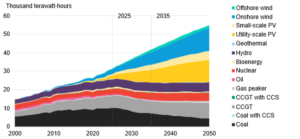
Source: Bloomberg NEF, New Energy Outlook 2026, reproduced with permission.
4. There is no single energy transition
The world is not transitioning as one system but fragmenting into regional pathways shaped by different starting points, resources, infrastructure, policy and financing costs. Asia-Pacific remains by far the largest energy-consuming region, while Africa is growing fastest from a smaller base.
China brings this split-speed transition to life. It generates more electricity than the US, EU and India combined and remains a major fossil-fuel consumer, yet in 2025 it installed 315GW of solar — around 60% of global additions — and EVs exceeded half of new car sales. That scale shows in the data: coal consumption was flat after years of growth and coal-fired generation fell, while oil demand kept rising, increasingly for chemicals rather than road fuels. India shows a milder version of the same tension: coal use rose only slightly in 2025 and gas demand fell while renewables expanded. Elsewhere the contrast is sharper still — the Middle East remains heavily hydrocarbon-dependent, while France’s electricity system is built around nuclear power, which supplies around two thirds of its electricity.
Electric vehicles provide one of the clearest examples of this transition already gathering pace , although adoption varies markedly between markets as below.
Global near-term passenger EV sales and EV share of new passenger-vehicle sales by market
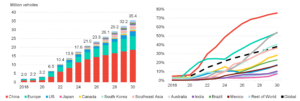
Source: Bloomberg NEF, New Energy Outlook 2026, reproduced with permission.
These examples show why the next phase is about systems, not just technologies. Solar, wind, batteries and EVs can scale quickly, but their impact depends on the infrastructure around them: transmission, storage, flexible demand, market design and faster permitting. In India, limited transmission has already kept clean power from being used. The bottleneck is shifting from deployment to delivery.
5. Energy security is driving structural change
The wars in Ukraine and the Middle East have returned energy security to the centre of policymaking. Historically, countries met an energy shock by switching within the fossil-fuel system, seeking alternative oil, gas or coal. Today they have wider options: solar, wind, batteries, EVs, heat pumps and smarter networks.
This is not about reducing energy services, but about changing how they are delivered. Today’s fossil-fuel system depends on extracting, shipping and burning fuel; an electricity-based system is built around generating power, storing it and using it more efficiently. After the upfront cost of building the technology and the ongoing cost of maintenance, the raw energy source for solar and wind is free. That makes the system less exposed to fuel-price swings and geopolitical disruption, where prices are shaped by global markets, supply constraints and political shocks.
Pakistan is an example: expanding solar has cut the need for imported liquefied natural gas (LNG), prompting the government to cancel cargoes scheduled for 2026 and 2027 and to renegotiate longer-term contracts. In Europe, wind and solar installed between 2022 and 2025 are estimated to have avoided €72 billion of fossil-fuel imports. Batteries, grids and electrification sit at the heart of this shift from fuel security towards system security.
WHAT THIS MEANS FOR INVESTORS
These points reinforce why decarbonisation and electrification sit within our JH&P five-point sustainability framework. They are not narrow environmental themes, but structural shifts that will shape economies, industries and markets over time. For investors, the importance lies in understanding how these shifts unfold through demand, costs, regulation, supply chains and capital allocation — and what they mean for company resilience and valuation. The question is not simply which technologies grow, but also which businesses are positioned to adapt, enable and benefit from the changes.
Companies do not operate in isolation. They operate within changing technological, economic and regulatory environments. Understanding these broader system changes can be just as important as analysing individual businesses. The transition is not confined to renewable generation; it is a systemic change across the infrastructure and supply chains that enable energy to be produced, moved, stored and used differently — from transmission networks and battery storage to electrical equipment, industrial efficiency, digital infrastructure and critical-material supply chains.
LOOKING AHEAD
Taken together, the data tells a story of acceleration, but not yet full substitution. Clean technologies are no longer marginal: solar is becoming a central source of new energy growth, electricity is taking a larger role in transport, industry and digital infrastructure, and batteries are beginning to change what is possible. The global energy system is still expanding and remains fossil-heavy, but emissions are rising more slowly than total energy demand, suggesting that growth and emissions are beginning to decouple.
The balance of growth is shifting towards renewables, electrification and efficiency, but the real test is delivery: whether grids, storage, flexibility, permitting, supply chains and capital can turn clean technology growth into lower fossil-fuel dependence and, ultimately, lower emissions. For investors, that creates both opportunity and risk: value may accrue to the companies enabling this transition, while incumbent business models that depend on slow system change may face growing pressure if policy, technology and capital move faster than expected.
Article written by Nicola Day, Partner, Portfolio Manager
This document is a Financial Promotion for UK regulatory purposes and is directed only at investors resident in the United Kingdom.
This document does not constitute investment advice or a recommendation.
Past performance is not a reliable indicator of future performance. The value of investments, and the income from them, may go down as well as up, so you could get back less than you invested.
This material has been issued and approved in the UK by James Hambro & Partners LLP, which is authorised and regulated by the Financial Conduct Authority and is a registered investment adviser of the Securities and Exchange Commission. It is listed in the Financial Services Register with reference number 513246. James Hambro & Partners LLP is a limited liability partnership registered in England & Wales with number OC350134 and registered office at 45 Pall Mall, London SW1Y 5JG. A list of members is available on request. The registered mark James Hambro ® is the property of Mr J D Hambro and is used under licence.